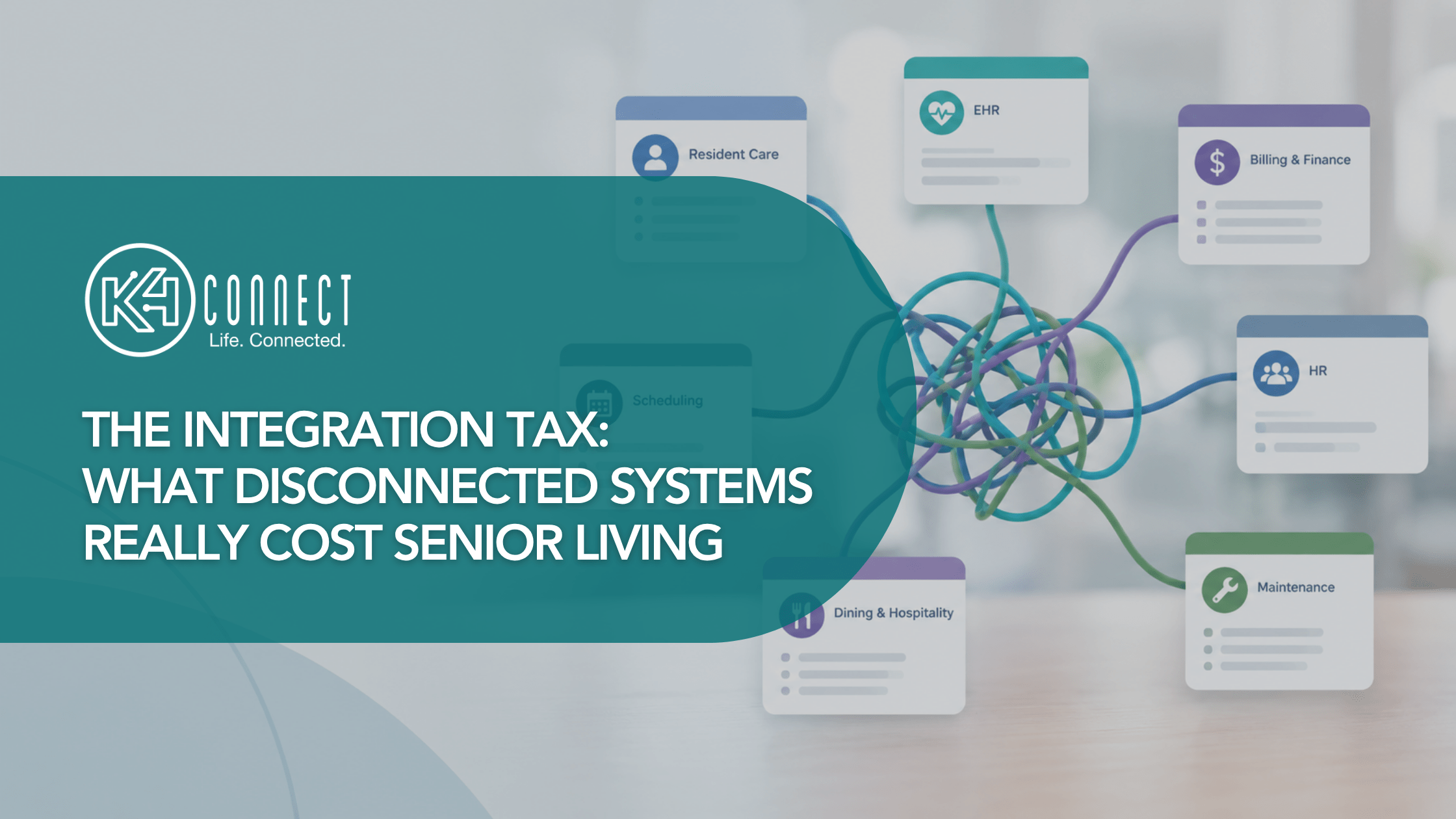
Senior living communities are investing in more technology than ever to improve operations, empower staff, and create better experiences for residents. But while the price of each technology solution may be clearly defined, there’s another cost that is much harder to see: the cost of making those systems work together.
When technology operates in silos, staff may spend hours entering the same information into multiple systems, reconciling data, switching between platforms, and creating manual workarounds just to complete everyday tasks. Over time, these small inefficiencies add up to a significant operational burden. We call this the Integration Tax: the hidden cost communities pay when their technology systems don’t talk to each other.
What Is the Integration Tax?
The Integration Tax doesn’t appear as a single line item on a budget. Instead, it shows up in time, effort, and resources required to keep disconnected systems running together. When systems operate independently, staff are often left to bridge the gaps between them, adding extra steps to processes that should be simple and seamless. Over time, these small points of friction can have a much greater impact, consuming valuable staff time, increasing operational complexity, and making it harder for communities to get the full value from the technology they have already invested in. The more disconnected the technology environment becomes, the more an organization can end up paying for the gaps between its systems.
The Hidden Cost of Disconnected Systems
The impact of disconnected technology extends far beyond the inconvenience of having multiple platforms. When systems don’t communicate, the gaps between them become part of the daily workflow. Staff have to spend additional time managing those gaps, information becomes harder to access and maintain, and organizations lose opportunities to work more efficiently.
Duplicate Data Entry
When systems don’t communicate with one another, information that should only need to be entered once may have to be recorded in multiple places. That repetition might seem like a small inconvenience, but across a community, it can consume significant amounts of staff time.
Staff shouldn’t have to serve as the integration layer between their technology systems. Their time is better spent supporting residents, collaborating with colleagues, and focusing on the work that requires a human touch.
Manual Reconciliation
Disconnected systems can also leave staff responsible for making sure information aligns across platforms. Whether they’re comparing resident information, reconciling schedules, reviewing operational data, or verifying records, these tasks require people to manually connect information that technology could be connecting automatically.
Every manual reconciliation represents time that could be directed toward residents, staff, or higher-value strategic priorities. And as the number of systems grows, so does the amount of information that needs to be checked and maintained.
Staff Switching Between Systems
A connected technology environment allows information to move naturally through a workflow. A disconnected one can require staff to constantly move between platforms to find what they need. Instead of completing a task in one seamless experience, an employee may need to remember which system contains a particular piece of information, log into multiple platforms, and move information from one place to another.
Errors and Inconsistent Information
The more manual steps a process requires, the more opportunities there are for something to go wrong. When information is maintained across separate systems, one platform may contain an updated record while another still reflects outdated information. Duplicate records, communication gaps, and inconsistencies can make it difficult for staff and leaders to know which information is accurate, ultimately slowing down the flow of information.
Importantly, the problem isn’t necessarily that any individual system is poorly designed or ineffective. The challenge is that those systems aren’t working together. Even good technology can create friction when it operates in isolation.
Incomplete Reporting
The Integration Tax doesn’t stop with frontline staff. Disconnected systems can also create challenges for leaders who need a complete view of what’s happening across their community.
When information is spread across multiple platforms, it can be more difficult to identify trends, compare data, create comprehensive reports, and make decisions based on a complete picture. Valuable information may exist within the organization, but if that information remains trapped in separate systems, its full value is difficult to realize.
Data becomes most powerful when organizations can connect it, understand it, and use it. Without that connection, even a community with plenty of data may struggle to turn it into meaningful insight.
The Integration Tax doesn’t just create inefficiencies today, it can also limit what’s possible tomorrow. As senior living organizations look toward automation and AI to improve operations and enhance the resident experience, the quality and accessibility of their underlying data becomes increasingly important. AI and automated workflows rely on information being available, consistent, and connected across the systems where it lives. When that information is siloed, incomplete, or difficult to access, opportunities for automation and intelligent decision-making become much harder to realize.
A connected technology environment creates a stronger foundation for what comes next. When systems can share information, communities have greater potential to automate repetitive workflows, surface meaningful insights, support more informed decision-making, and develop more personalized experiences for residents. In other words, connected systems don’t just make today’s technology work better, they create more possibilities for tomorrow’s technology.
How to Reduce the Integration Tax
You Can’t Automate What You Can’t Connect
Reducing the Integration Tax doesn’t necessarily mean replacing every system a community already has. Instead, it starts with taking a closer look at how those systems work together and where gaps are creating unnecessary work. The goal is to build a technology environment that supports staff rather than requiring them to constantly work around it.
Prioritize Interoperability
When evaluating technology, communities should look beyond what an individual solution can do on its own and consider how well it can connect with the systems already in place. Technology should be able to share information and support workflows across the broader technology environment rather than creating another isolated silo.
Look for Opportunities to Automate
A useful question to ask is: What are our staff doing today that technology could be doing automatically? Identifying repetitive manual processes can reveal opportunities to reduce administrative work, improve consistency, and give staff more time to focus on higher-value responsibilities.
Think Beyond Individual Systems
Technology decisions shouldn’t happen in isolation. A solution that works well on its own may still create challenges if it doesn’t fit into the larger ecosystem. Communities should consider how a new technology will affect existing workflows, data, staff responsibilities, and future technology investments before adding another platform.
Build for What’s Next
Technology environments need to be able to evolve. As automation and AI continue to develop, communities will need technology that can support new capabilities rather than technology that creates additional barriers. Building a connected foundation today can make it easier to adopt and take advantage of new tools tomorrow.
Ultimately, reducing the Integration Tax is about creating a technology environment where systems work together, information moves where it needs to go, and staff can spend less time managing technology and more time using it to improve the work that matters.
Stop Paying the Integration Tax
Senior living communities are already making significant investments in technology. The next question is whether they’re getting the full value from those investments. The true cost of technology isn’t limited to the price of a software subscription. It also includes the time spent working around disconnected systems, the errors created by manual processes, the complexity of managing multiple platforms, the insights that remain trapped in silos, and the opportunities for automation and AI that may never be realized.
Technology should make work more connected, not more complicated. When systems can communicate and information can move seamlessly across the organization, communities can reduce unnecessary work, make better use of their data, and create more capacity for what matters most.
The Integration Tax may not appear on a budget sheet, but its impact can be felt throughout an organization.
So, how much is your community paying for systems that don’t talk to each other?